As teachers, we know the importance of feedback in advancing our students’ learning. We see it in our classrooms in those magic moments when their eyes light up after we suggest a new way to solve a problem or write a thesis statement.
This importance is also shown in educational research. In John Hattie’s most recent Visible Learning book (2023), he presents findings from his meta-synthesis of feedback research, which show a medium-to-strong impact (.51 ES) of feedback on student learning. Wisniewski, Zierer, and Hattie (2020) replicated much of the first round of Visible Learning feedback research in a meta-analysis of their own and found similar results (.48 ES).
[In my previous post, I discussed peer feedback: research on its potential for impact, recommended strategies, and ideas for implementation (read it here).]
But just because feedback is important doesn’t mean it’s easy to do well.
In fact, it can be pretty hard. It can be difficult to provide feedback consistently throughout a unit. It can also be tough to give quality feedback to all of our students. And it can be hard to differentiate feedback for students in different phases of learning (e.g., beginning vs. proficient).
Then there is the matter of time. When we are juggling so many responsibilities and tasks, such as lesson and unit planning, assessment creation, classroom instruction, behavior management, parent phone calls, attending IEP meetings, learning team meetings, and grading, it can be hard to prioritize the time for feedback.
And even if we find the time and make it consistent for all students, there is the very real problem of getting students to use it.
In their research, Hattie (2023) and Wisniewski et al. (2020) found something that seems to encapsulate these real-world teacher problems: variability of feedback impact is high; thus, not all feedback is effective.
In other words, although feedback, on average, can have a mid-to-high impact on student learning, some forms of feedback have high impact, some have low impact, and some even have a negative impact.
For teachers, navigating this variability can be challenging and even confusing. But this is where research can be extremely helpful. Hattie provides a feedback protocol to address variability in two aspects of feedback: a) type and b) phase of learning.
Understanding The Protocol
Here, I present my interpretation of John Hattie’s protocol with the high school classroom in mind. My thinking considers the use of this protocol within the balance among the teacher, the student, and the learning content/standards (what City et al. (2009) refer to as the instructional core).
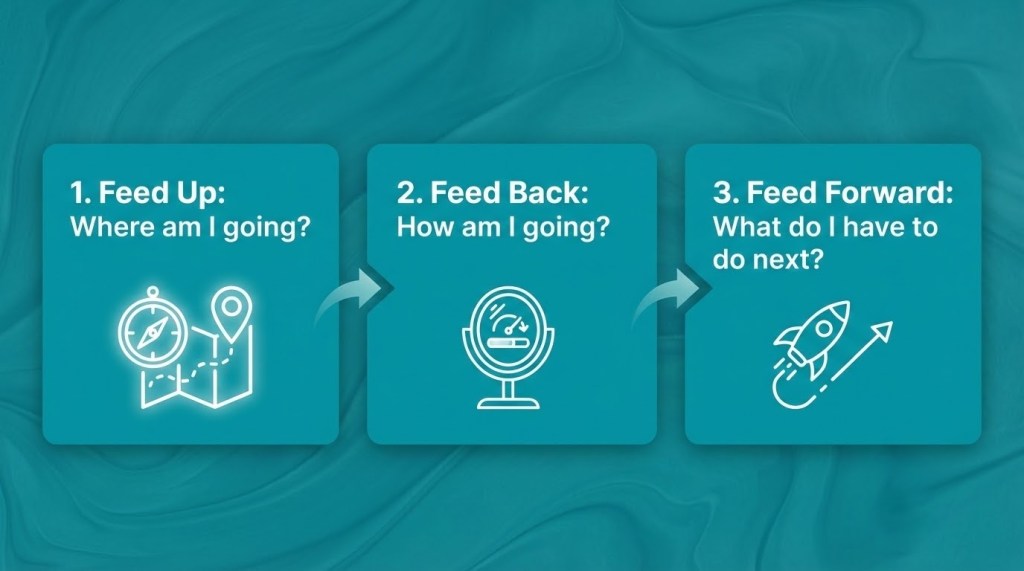
The three stages of Hattie’s protocol are shown below. The top of each stage is guided by a feedback type (Feed Up, Feed Back, and Feed Forward) and an accompanying question. Within each stage are strategies for three progressive phases of learning: beginning, proficient, and mastery.
Figure 1: Hattie’s Three Stages of Feedback
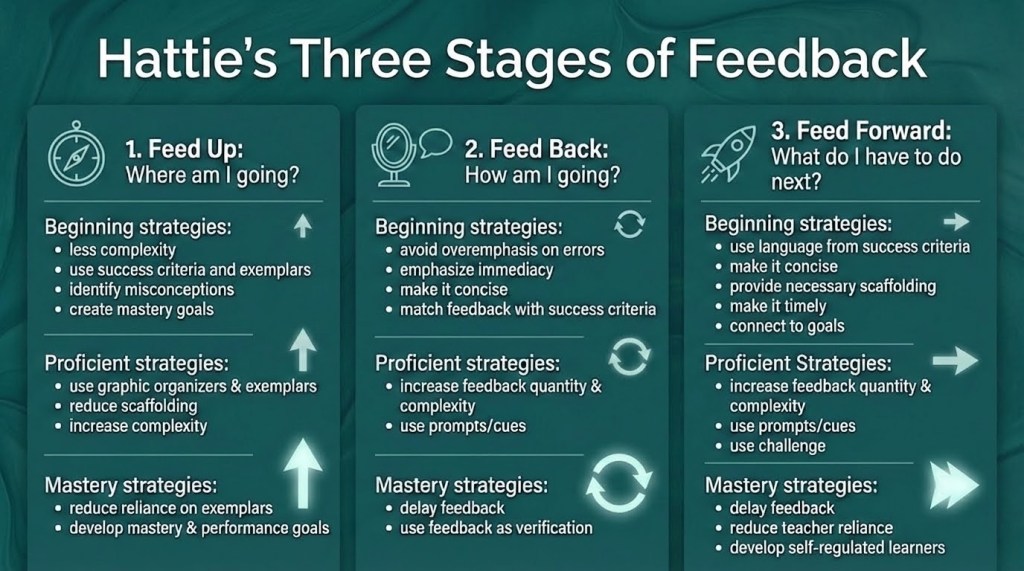
Note. Adapted from Visible Learning: The Sequel (p. 322-323), by J. Hattie, 2023, Routledge. Copyright Year by Copyright Holder. Modified with the assistance of Google’s Gemini (2026).
Stage 1: Feed Up
Stage 1, the Feed Up Stage, is guided by the question “Where am I going?” Here, teachers and students focus on clarifying learning goals and success criteria. Without this stage in place, the next two stages are unlikely to be effective.
In the Beginning Phase, the teacher simplifies the target by providing success criteria that can serve as a checklist, along with exemplars that display the success criteria. As students progress to the Proficient Phase, the teacher’s clarity about learning expectations becomes more complex and nuanced — both in description and in exemplars. At the Mastery Phase, the teacher removes exemplars to encourage originality and emphasizes helping students develop purpose-driven mastery and performance goals.
Stage 2: Feed Back
The Feed Back Stage includes the guiding question “How am I going?” In other words, the feedback focuses on informing students about their progress towards learning goals. This includes informing them about problems that need correction as well as successes that they should continue.
Hattie (2023) offers helpful guidance on providing feedback on student errors. He reminds us that “feedback thrives on errors,” which is important to keep in mind–especially for teachers who balk at giving negative feedback. And he continues, “in conditions where students perceive low rather high levels of threat to self-esteem” (p. 324). Thus, teachers must establish a classroom culture of feedback that emphasizes a growth mindset, including classroom policies that support that culture. But when classwork and homework are graded, teachers judge student quality during the delicate learning stage, which can prevent students from embracing a growth mindset and using the feedback.
In the Beginning Phase, the teacher’s feedback concisely points out a small number of errors and praises an equally small number of effective elements of the task. All feedback aligns with the success criteria. At the Proficient Phase, the teacher can increase the quantity and complexity of feedback. Also, the teacher is less prescriptive, using prompts and cues to guide students to the correct answer or revision. At the Mastery Phase, some feedback may just be verification that students are on the right track before continuing on their course. Additionally, teachers can delay feedback to promote students’ ownership of learning without relying on the teacher at every step. Additionally, delayed feedback requires additional student reflection and retrieval, which can help to solidify learning in a student’s long-term memory.
Stage 3: Feed Forward
Stage 3, the Feed Forward Stage, is guided by the question “What do I have to do next?” Here, teachers apply information from the Feed Up and Feed Back stages to guide students to subsequent learning steps.
In the Beginning Phase, teachers provide students with concise, immediate advice on next steps explicitly connected to success criteria and learning goals. Teachers may provide them with templates and other scaffolds to help with these next steps. In the Proficient Phase, the next steps can increase in quantity and complexity. Teachers may use prompts or cues to generate additional student thinking about where to go next, and they may challenge students with increasing levels of rigor. In the Mastery Stage, teachers may delay sharing explicit next steps to allow students to determine them on their own. Teachers may also require students to explicate the next steps themselves, with the teacher merely confirming the path.
Using the Protocol in My Classroom
I’m using this protocol in my classroom to be more strategic in my feedback, as I realize the variability in my own effectiveness. I also recognize that I can be more efficient in the time I devote to feedback.
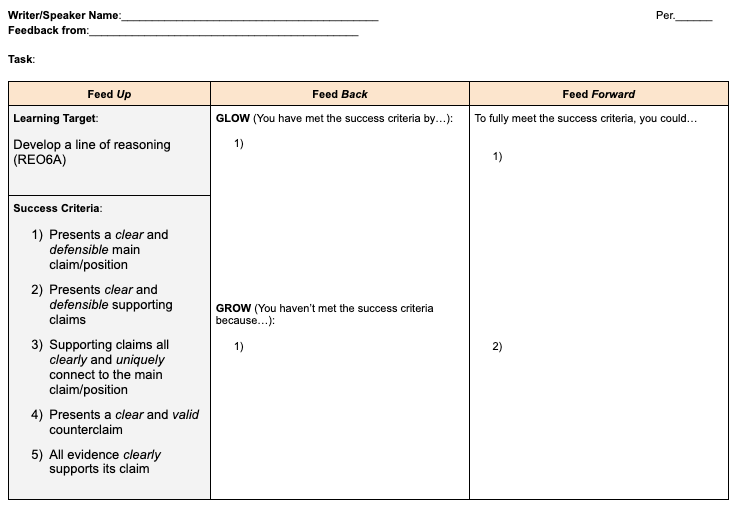
Figure 2 below shows a recent adaptation of the protocol I’m using in a new argument unit in my AP English Language and Composition classes. Students are beginning a new priority target: develop a line of reasoning. Earlier in the year, this was a supporting target, but it is now prioritized for the first time. This means all students are expected to reach at least the proficient level, but the goal is mastery. It also means that, for the first time, it will be included in the summative assessment and eventually be included in their grade.
Figure 2: My Classroom Feedback Form: Applying Hattie’s Three Stages of Feedback
In an early task, students chose one of four argumentative prompts and, in a group of three, developed an outline of a line of reasoning. The final product was a brief presentation to the class, using two slides to outline their line of reasoning. The entire task, including presentations and mini-lessons on claims and evidence, took approximately a week.
I used the protocol and feedback form in two ways:
1. Oral Feedback During the Task
We began with the learning target and success criteria, and we connected back to the target at least twice each day. As students worked together, I observed, checked in, and provided feedback. I recognized most students were at the beginning stage of the learning progression, so my feedback was pretty prescriptive. In most groups, I addressed two or three stages of feedback with each check-in.
For groups that were early in the beginning phase, I spent more time focusing on the success criteria in the Feed Up stage. But with groups farther along, this wasn’t necessary, and I moved to the next two stages.
Since this was the beginning of the unit, most of the Feed Back and Feed Forward was concise, immediate, and explicitly connected to success criteria. In the Feed Forward Stage, in particular, I gave specific next steps that aligned with our success criteria. However, a few groups were at the proficient stage, so I added more nuance and detail to my feedback. Sometimes, I asked these groups what their next steps should be, and I just confirmed.
2. Written Feedback During Presentations
After each group presented, I completed the feedback form. I also required all students to complete the form as peer feedback for at least four groups. As the form shows, the feedback was to be concise, align with the success criteria, and begin with a sentence frame.
This written feedback is much more delayed than the instant feedback I gave orally during the task. However, I think it can be beneficial in two ways. One is that as my students wrote the peer feedback, they continued to think about the success criteria and the parts of argumentation that their peers presented. At this early stage of learning, I see thinking and writing as important to the internalization of success criteria. In other words, as they wrote the Feed Back and Feed Forward for their peers, they were increasing the Feed Up in their own minds.
Another benefit is that the delayed feedback, which Hattie suggests for later phases of learning, can still be beneficial for reflection and retrieval at this early stage. This is my plan for our next steps in the unit.
Using the Feedback
Students primarily used the oral feedback I provided to increase their learning during this task. However, they will be using the written feedback from both their peers and me for an upcoming task. The follow-up, which I plan for the following week, is for each student to write a full essay using their group outline and the feedback.
As they work in class, I will be asking them to share with a shoulder partner every 15 to 20 minutes about “how they’re going” and “where to next.” In this verbal self-assessment, I will prompt students to explain how they’re using the feedback they received and what feedback, if any, they still require.
What Do You Think?
Can you see this working in your classroom?
What resonates with you?
What do I need to clarify?
Let me know!
References
City, E. A., Elmore, R. F., Fiarman, S. E., & Teitel, L. (2009). Instructional rounds in education: A network approach to improving teaching and learning. Harvard Education Press.
Hattie, J. (2023). Visible learning: The sequel—A synthesis of over 2,100 meta-analyses relating to achievement. Routledge.
Wisniewski, B., Zierer, K., & Hattie, J. (2020). The power of feedback revisited: A meta-analysis of educational feedback research. Review of Educational Research, 90(6), 831–871. https://doi.org/10.3102/0034654320957025
 Practical Classroom Solutions to Grading and Assessment