
On July 20, 1969, humans set foot on the moon for the first time. The Apollo 11 mission was a great success, with Neil Armstrong taking the first “small step,” followed by Buzz Aldrin about 20 minutes later. This was a momentous occasion for NASA and the United States, fulfilling President Kennedy’s 1961 goal of putting a man on the moon by the end of the decade and scoring a major battle in the Space Race. It also signaled a giant leap forward for humankind, marking major scientific and technological advancements and inspiring generations to pursue the STEM fields.
But just two years earlier, NASA experienced one of its greatest failures in the program’s history. In January of 1967, at the Kennedy Space Center in Cape Canaveral, Florida, the Apollo 1 mission literally went up in flames. In a test mission, a fire broke out due to faulty wiring in the space capsule. The fire spread quickly due to the 100% oxygen environment, and it led to the inside hatch being completely sealed. The three astronauts inside died. It was a tragedy.
However, NASA didn’t concede the failure of the Apollo program. It didn’t move on to a new project.
This was their response:
- No manned flights for over a year.
- A complete safety overhaul, including over 1,500 changes.
- A change in the atmosphere in the pod from 100% oxygen to an oxygen/nitrogen mix.
- An outward-opening hatch to prevent sealing inside.
If NASA had applied the thinking of traditional K-12 assessment and grading systems, the program would have failed and ended. It would have moved on.
Instead, it maintained its goal of landing on the moon because the goal was important. It took time to review and learn from its mistakes. It made corrections, which included multiple iterations. And it eventually got it right.
Making ‘All’ Mean ALL
In the 21st century, K-12 schools also have a critically important goal. This goal is crucial to the future welfare of our society, and it differs markedly from that of much of the previous century.
This goal is to ensure that all students attain academic success.
In the past century, we didn’t explicitly link “all students” with “academic success.” It was about “equal access” and “equal opportunity.” And as long as resources were available, the primary responsibility for success rested on the individual students and their parents. However, with today’s new societal expectations for our schools, the school systems and the educators who run them bear a major responsibility as well. And although we may never reach this goal of academic excellence for all, it remains our measure of systemic success. Thus, we will continue to view our system as failing as long as individual students and specific student groups fall short of the goal.
In all likelihood, your school’s website includes a mission statement that articulates such a goal, perhaps similar to the example below.
Our mission is to ensure that ALL students achieve academic excellence, develop critical thinking skills, and become responsible, productive citizens prepared for success in college, career, and life.
Example school mission statement
Such a critical and challenging goal requires schools to regularly reflect and assess their progress in ensuring that “all” really means ALL, using a few guiding questions:
- What steps are we taking to ensure ALL of our students are meeting these high expectations?
- How effective are these steps at ensuring ALL of our students meet these high expectations?
- What next steps should we take to ensure ALL of our students meet these high expectations?
After reflecting on these questions, schools can decide on a range of interventions and programs to move toward the goal of “all students.” But the most expensive and complex options aren’t always the best. In addition to the price tag, developing elaborate Tier 2 and Tier 3 systems can be time-consuming and distracting from the essential Tier 1 work happening in the classroom every day.
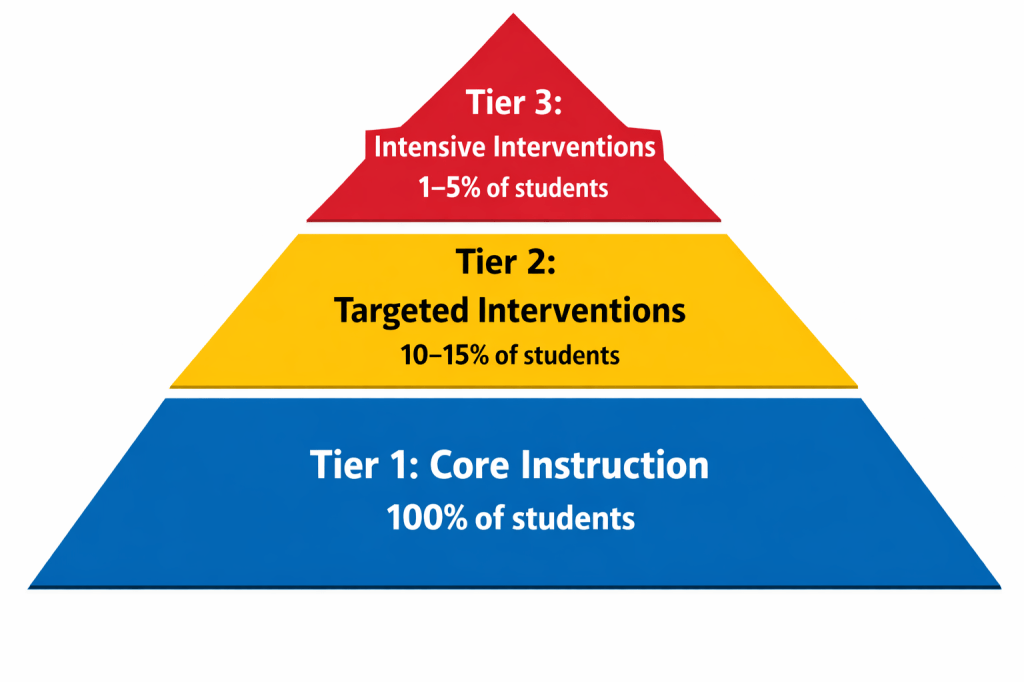
Many times, the simplest solution is the best (think Occam’s razor). And in this case, that solution can be making the most of the structure and resources available within the classroom. This means effective Tier 1 core instruction and systematic in-class Tier 2 targeted interventions (see Figure 1 below).
Figure 1: The Response to Intervention (RtI) Pyramid (read more here).
Here’s what that can look like in the classroom in 4 iterative steps:
- Rigorous, standards-based core instruction (Tier 1).
- Ongoing formative assessment cycles (formative assessment-targeted feedback-additional practice) (Tier 1).
- High-quality summative assessment (Tier 1).
- Mastery learning reassessment: (Tier 2).
In these four iterative steps, which apply the principles of the RtI pyramid, teachers can guide the vast majority of their students to academic success on their priority standards with little-to-no use of outside interventions (note: Tier 2, meant for 10-15% of students, may use some outside interventions).
Although each step deserves a great deal of detail and attention, the rest of this post is only devoted to step #4: mastery learning reassessment.
What is a Mastery Learning Reassessment System?
Similar to NASA’s engineering system in the 1960’s, a mastery learning reassessment system operates on several core principles to achieve success: high expectations to meet important goals, additional time to achieve goals when they haven’t been met the first time, correctives to fix problems, additional opportunities to demonstrate success, and a structure that ensures the process is consistent and efficient.
Below are essential elements of a mastery learning reassessment system in the school context, broken into three parts.
| Mastery Learning | Reassessment | System |
|---|---|---|
| – An expectation that all students will be successful – Necessary time to meet learning goals – Targeted feedback – Corrective instruction & learning activities – Learning extension opportunities | – Multiple opportunities to display learning – No grade limits or penalties – Equally valid assessment of learning | – Strategic structure designed for consistency and efficiency -All students receive equal opportunities to reach learning goals |
Mastery Learning
The mastery learning process was first fully developed and popularized by Benjamin Bloom. In his 1971 paper, Bloom explained that, given sufficient time and appropriate learning conditions, nearly all students can reach high levels of learning. He expanded on this model over time, but I take five core components from Bloom’s model and apply them to a mastery learning reassessment system.
- Expecting all students to learn at high levels, and believing that they can.
- Providing necessary (additional) time for students to meet learning goals.
- Giving targeted feedback on initial learning attempts (see my past post on the Feed Up, Feed Back, Feed Forward protocol).
- Delivering corrective instruction and learning activities that guide students in the right direction, but in a different way from before.
- Offering engaging, challenging learning extension opportunities for students who reach learning goals more quickly.
Reassessment
By reassessment, I mean providing students with additional opportunities to demonstrate their summative learning of priority standards. Sometimes called retakes, these opportunities should parallel the original assessment in rigor and validity. And because we’re removing time as a limiting variable in students’ learning, reassessments are scored the same way as the original assessment — with no grade penalty or limit for requiring additional time.
System
Here, the word “system” means that reassessment comprises multiple parts and serves a broader purpose — in this case, helping all students achieve mastery of the priority standards. Effectively doing so provides all students with equal opportunities to meet rigorous learning goals efficiently within the current structures of the classroom.
So, because it is a systemic process, all students have this opportunity — not just those who ask for a retake or have a compelling reason to try again. And teachers can communicate the policy transparently, which builds trust and equity in the classroom. When the system is designed strategically, it is efficient for both teachers and students, preventing the stress and burnout that commonly accompany reassessment.
Implementing a Mastery Learning Reassessment System
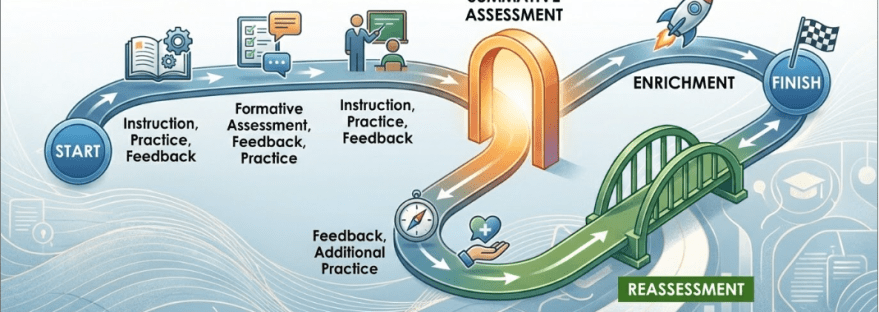
When considering how to implement a mastery learning reassessment system in your own classroom, it can help to reframe the process as simply extending students’ learning pathway, as illustrated in Figure 2 below. In this case, the “learning pathway” refers to students’ path from the start of a unit to achieving success at the finish line.
Figure 2: Extending the Learning Pathway with a Mastery Learning Reassessment System.
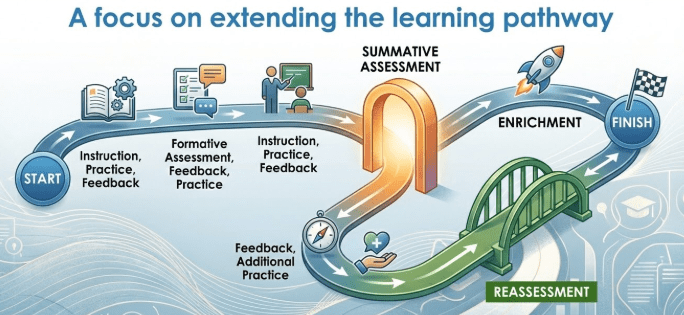
But so often, students in the traditional classroom fail to achieve success and thus never cross the finish line. In other words, their learning pathway is cut short. So the goal in the mastery learning reassessment system is to extend the learning pathway beyond the traditional route to help all students reach the finish line. And for students who achieve success more quickly, there is an alternative course.
To implement mastery learning reassessment in the classroom, I suggest teachers plan and address four key factors: time, learning, assessment validity, and grading. Below, I present guiding questions for teachers to ask themselves that address these four factors, each with a practical consideration, an example policy statement from my own 11th-grade ELA classroom, and a “pro-tip.”
4 Guiding Questions for Implementation
Question 1: How will I ensure students have adequate time for additional learning and reassessment?
Practical Considerations: Teachers should consider how long students may need to continue learning if they haven’t yet achieved success on priority standards after the initial summative assessment. More specifically, they should consider the time required to provide feedback and give additional targeted instruction, as well as how long students will need to engage in additional practice. Finally, teachers should consider the time needed to reassess.
It’s likely that the time required for the whole process will occur both in and out of class, so teachers should consider this when planning. However, it’s important that a large proportion of the time is spent in class, including instruction, some practice time, and the actual reassessment. If this isn’t the case, it will be nearly impossible for teachers to help all students reach the targeted learning goals. Often, teachers plan one to two weeks for targeted in-class learning and assessment, with longer windows when out-of-class learning time is included.
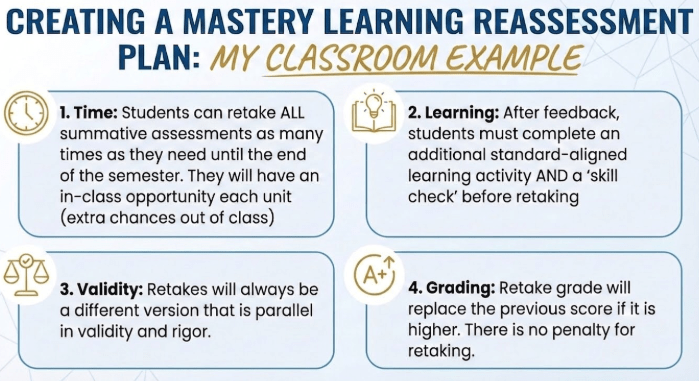
My Classroom Policy: Students can retake ALL summative assessments as many times as they need until the end of the semester. However, students have a week after I return the assessment for in-class opportunities and a reassessment. Additional opportunities are coordinated outside of class time.
Pro Tip: Plan for this additional learning and reassessment time with your learning team in the summer when you’re creating or revising your pacing guides. That way, it’s built into your plan, and you don’t feel perpetually behind in the school year while you’re working to help all students succeed.
Question 2: How will I help students deepen their learning using correctives?
Practical Considerations: The use of correctives should include some targeted instruction to address gaps in a student’s learning, along with practice to further develop the learning. Both instruction and practice usually need to be presented in new ways, since students didn’t get it the first time around.
To make differentiated instruction manageable in the classroom, teachers may identify a small number of common, high-leverage “gaps” in students’ learning pathways (around 3-4) to provide instruction and practice in small groups (groups are organized by learning gaps). These gaps may be specific to standards, learning targets, or steps within a learning progression. The goal of the corrective is to fill the gap in the pathway so students can reach the learning goal.
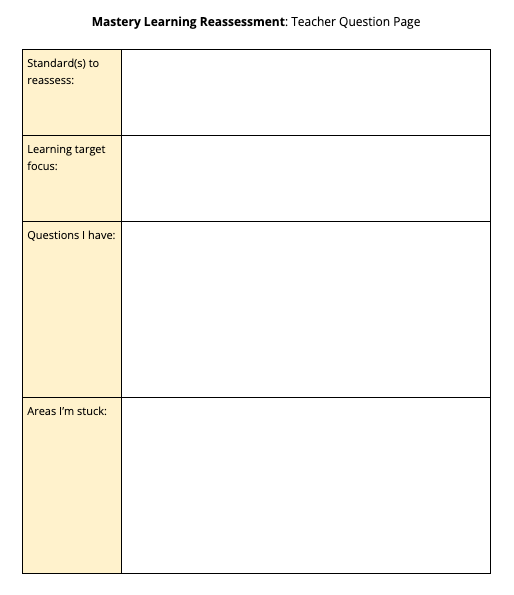
When the teacher provides direct instruction and additional feedback to one group, the other groups work on independent practice, using the previous feedback as a guide. The teacher may also provide students with a paper for recording questions and areas of confusion that arise during their practice, which he can later address when he meets with each group. Below is a simple example of this (see doc here).
As a reminder, students who don’t require reassessment (ideally 85-90% of students) engage in learning extension activities during this time. Although the possibilities for extensions are endless, teachers may consider challenging students to apply priority standards in new ways or to choose a supporting standard that wasn’t directly taught and learn about it. It can be good practice to organize these students into groups as well, so they can support one another and improve their collaboration skills.
My Classroom Policy: After I provide feedback, students must complete an additional standard-aligned learning activity AND a “skill check” before retaking. The activity is a variation of the original activity, and the skill check is me checking in with them (or their practice) to ensure their learning is progressing.
Pro Tip: Early on, inform students about the reassessment requirements and the opportunities for those who achieve success early. This increases transparency and trust in the classroom and incentivizes students to put in time and effort before the first assessment. I often remind my students: “To succeed on these standards, you will have to put in the time and effort at some point. But it will be much easier for you and me if you do it before the first assessment.”
Question 3: How will I ensure that each reassessment is parallel in validity and rigor to the original assessment?
Practical Considerations: It can help to create multiple versions of the assessment before the unit begins, as there will always be students who need to reassess. I recommend three or four versions to be plenty prepared. This also allows teachers to vary the assessments they use across classrooms and across periods, which reduces incidents of cheating (increasing construct validity).
My Classroom Policy: Retakes will always be a different version that is parallel in validity and rigor.
Pro Tip: It’s helpful to inform students early and often that the reassessment will always be a different version of the original. This can prevent students from failing to take the first assessment seriously (a common fear among teachers considering reassessment).
Figure 3: My Classroom Reassessment Policy, Aligned With 4 Guiding Questions.
Question 4: How will I ensure my grading is fair and equitable?
Practical Considerations: Create a grading policy that communicates current student learning, not the timing of learning or behaviors adjacent to it. This means past scores, time, and effort shouldn’t be considerations. Thus, averaging the original assessment score with the reassessment score can’t be used, as it would reflect past learning. Also, capping a reassessment score at 85%, for example, can’t be used because it penalizes students who require more time to learn.
A simple guideline is to keep the grading policy clear and simple by grading the reassessment in the same way as the original assessment.
My Classroom Policy: The reassessment grade will replace the previous score if it is higher. There is no penalty for retaking. (Wondering why? See my upcoming post on my rationale.)
Pro Tip: In the gradebook, add a comment or label indicating whether a score was from the 1st, 2nd, 3rd, etc., assessment. Although the grade shouldn’t reflect how long it took the student to learn, data on learning time can be helpful to the teacher, parent, and counselor.
Taking the First Steps
Here are three small first steps to begin implementing a mastery learning reassessment system. These steps are designed for the teacher who doesn’t have a formal policy in place.
1. Focus on 1 Standard and 1 Reassessment
- Identify one standard that many students struggled with on a recent summative assessment.
- Inform students that everyone who didn’t reach a minimum targeted performance level (whatever your goal is, such as “proficient”) will have an in-class opportunity for one reassessment.
2. Plan a Learning Opportunity Between Assessments
- Provide each struggling student with specific feedback on that standard.
- Reteach a lesson on that standard, but present it in a different way.
- Provide struggling students with a practice opportunity that mirrors the summative assessment.
- Provide students who have already reached the learning goal with a learning extension opportunity (consider having them create assessment items for that standard, along with an answer key/scoring guide).
3. Establish a Clear, Simple Reassessment Policy
- Clarify how you will grade the assessment.
- Announce when the reassessment will take place.
- Communicate the learning requirement before reassessment.
From Small Steps to a Giant Leap in Learning

When Neil Armstrong took his first steps on the moon, he spoke the famous line: “That’s one small step for man, one giant leap for mankind.” In some ways, the shift to a mastery learning reassessment system can feel the same. For the individual teacher, the first steps — offering a reassessment on a single standard, ensuring some learning occurs before reassessment, or establishing a simple policy — can seem small and even uncertain. But each successive step, such as providing targeted corrective instruction, determining grading policy, and creating multiple versions of the assessment, adds impact and confidence.
Taken collectively, these small steps represent a profound shift in how we conceptualize learning, set expectations, and support students. And when such a system is compounded across classrooms and schools, these steps can truly lead to a giant leap in meeting our goal that all students attain academic success.
 Practical Classroom Solutions to Grading and Assessment