
When I talk with teachers and leaders about creating a reassessment system, one of the most common concerns they have is about grading.
I often hear questions like Should all students be allowed to reassess, or only those below a certain score? Should the reassessment score replace the original score, or be averaged with it? How do we prevent “grade grubbing” while still supporting learning? Should there be a cap on reassessment scores?
And so on.
The grading of reassessments — like most other grading contexts — sits at the intersection of beliefs, systems, and practical realities. In other words, it goes beyond procedures, and it can be complicated to get right. Further into this post, I delve deeper into the complexities of reassessment grading policies, but first, here is some context on reassessment.
Reassessment Principles
In my previous post, I went into detail about creating a mastery learning reassessment system (MLRS) (read it here), including what it is, why it’s important, and how to implement it.
In the post, I defined this system as a comprehensive process designed to help all students meet important, rigorous learning goals by providing additional and necessary learning time, facilitating additional learning opportunities, ensuring equally valid and rigorous reassessments, and grading in a fair and equitable way.
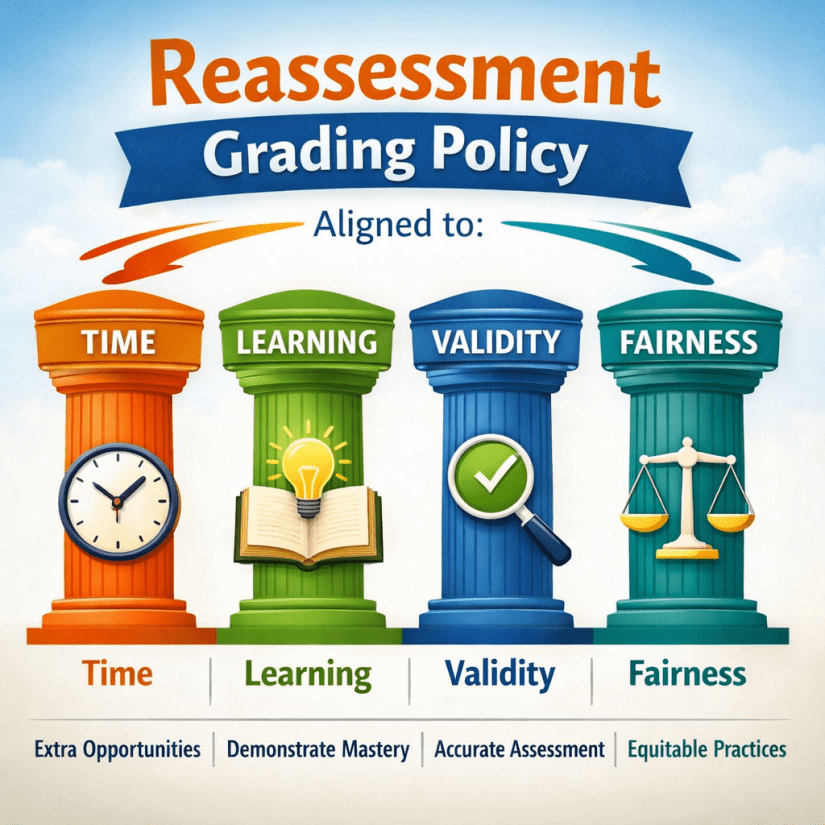
This definition applies four factors for teachers to consider when developing their own policies and systems: time, learning, validity, and grading.
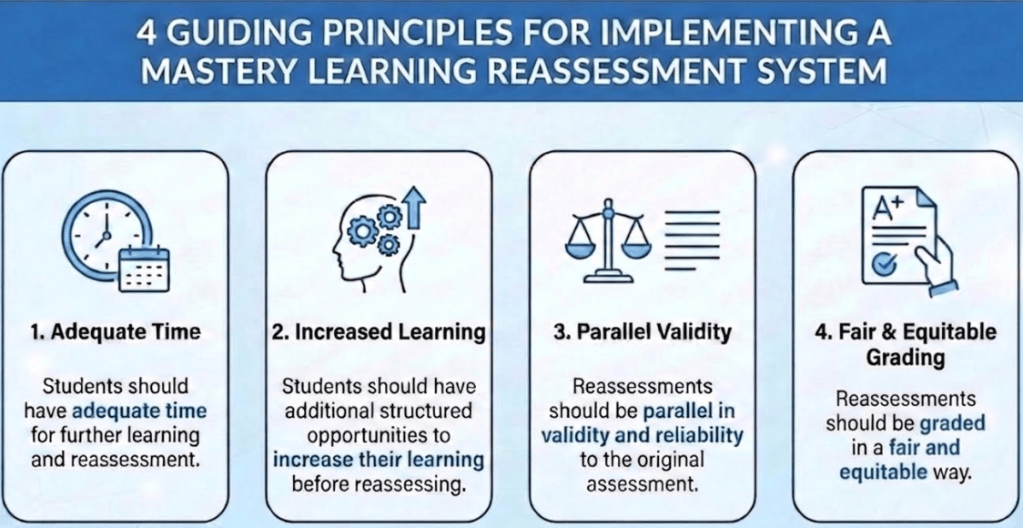
Below, I have expanded these factors into four principles to provide additional guidance for educators as they create such a system:
- Students should have adequate time for further learning and reassessment.
- Students should have additional structured learning opportunities to increase their learning before reassessing.
- Reassessments should be parallel in validity and reliability to the original reassessment.
- Reassessments should be graded in a fair and equitable way.
Although the first three principles raise many logistical questions, the fourth principle, focused on grading, often raises different types of questions — ones related to educational philosophy and personal values. From my perspective, such questions require a more nuanced and detailed answer.
Thus, the fourth MLRS guiding principle—reassessments should be graded in a fair and equitable way—is the subject of this post. Below, I present ideas for applying this principle in practice by contrasting it with common reassessment grading policies. I conclude with a policy that I present as fair and equitable, and that also aligns with the principles of time, learning, and validity. It is also the reassessment grading policy that I use in my own high school classroom.
Figure 1. Four Guiding Principles for Creating a Mastery Learning Reassessment System
A Review of 5 Common Reassessment Grading Policies
Below are five common reassessment grading policies that I’ve seen or heard from teachers around the country. While I recognize that teachers often use these policies to address a particular purpose or problem in their own classrooms, I consider each to be problematic or flawed in one or more ways, using the four MLRS guiding principles as premises. For each of these policies, I explain the guiding principle it violates.
Common Grading Policy #1: Students scoring lower than 80% on the first assessment are eligible for a reassessment.
This policy limits reassessment to students who score a C, D, or F on the original assessment; students scoring an A or B aren’t eligible. The common rationale is that the policy helps ensure reassessment benefits those who need it most — those scoring a C or lower —and that it’s not just used by “grade grubbers” who want to inch up their grades. (Note: There are many variations of this policy, but the rationale is usually the same.)
One problem is that the policy excludes a segment of students who are neither high nor low achieving—those scoring in the “B range.” Depending on the grading scale teachers use, students scoring at 80% or higher may not have reached what is considered academic success. So, although a B isn’t bad, it eliminates the possibility of reassessment, undermining these students’ motivation and any opportunity to continue and deepen their learning in this area.
Another problem is that the policy can disincentivize students from putting in high effort on the initial assessment if they aren’t confident they will earn at least an A. After all, scoring 80% means no second chance, but scoring 79% or lower means they can prepare better and try again.
As a result, these problems mean that such a policy violates the guiding principle of fair grading and equitable (#4).
Common Grading Policy #2: Students can recover half of their missed points by completing test corrections.
This well-meaning policy is often used by teachers to help students raise their grades after scoring poorly on the test. It’s particularly common in elementary school, but it’s also in use at the middle and high school levels.
The main problem here is that the policy is grade-centric rather than learning-centric. Anytime a teacher offers students opportunities to raise their grades without a direct connection to increased learning of grade-level standards, it undermines the integrity of grades and reinforces the idea that the most important part of school is earning high grades, not learning at high levels.
Test corrections, when completed, aren’t valid evidence of higher learning. This is because students are simply seeking to correct the mistakes the teacher has indicated (often after feedback). Thus, this practice violates the guiding principles of increased learning (#2) and parallel validity (#3).
Common Grading Policy #3: Students can score up to an 88% on their reassessment.
Teachers using this policy typically cap reassessment scores because they believe it is fair to students who earned high scores on the original assessment. The idea is that it’s more difficult to achieve at a high level on the first attempt, so the grading policy should acknowledge and reward this difficulty.
But this misguided sense of fairness violates reassessment principles of adequate time (#1), parallel validity (#3), and fair and equitable grading (#4). Because content standards almost never include time as a factor, teachers should not consider it in their grading—if they intend their grades to be accurate measures of students’ academic achievement. Furthermore, the idea that it’s more difficult to achieve at high levels the first time is usually based on the assumption that the second assessment is less rigorous and valid than the first. If this is true, the teacher first needs to update their reassessments to ensure the assessments are parallel in quality
Finally, although this policy doesn’t overtly exclude any students from reassessing, it disincentivizes anyone scoring lower than 88% from continuing the learning process. And the limit, or “cap” on the reassessment grade, means those scoring above 88% will not receive full recognition for their learning, resulting in an unfair grading policy despite the best intentions behind applying fairness in policy.
Common Grading Policy #4: Reassessment score(s) will be averaged with the previous score(s) for a final grade on the assessment.
When teachers average reassessment scores with the original assessment score, it’s usually for the same reasons as in Common Policy #3: They believe each reassessment attempt becomes easier to reach the learning goal; therefore, they reason, the grading policy should acknowledge the difference in difficulty between the original attempt and each subsequent attempt.
However, as in Common Policy #3, flawed assumptions about learning time and assessment validity mean this policy violates the reassessment principles of adequate time (#1) and parallel validity (#3).
The problem regarding fair and equitable grading (Principle #4) is somewhat different in this case. When students demonstrate learning success on a particular standard or target, there is no need to include records of lower scores on the same standard or target in their grades. But averaging assessment scores does just that, essentially punishing students for past mistakes.
However, if we consider past assessment attempts as part of the learning process (and formative in nature), then the summative assessment is defined as the last assessment in that process. Therefore, fair (and accurate) grading would mean reporting only the last assessment score — if we believe it is the most valid evidence of student learning.
Common Grading Policy #5: The most recent reassessment score will replace the previous assessment score.
This final common reassessment grading policy is the most nuanced, so I’ve saved it for last. Up to this point, we’ve seen four common policies that have fairly obvious flaws when examined closely, and according to the four principles presented at the beginning of this post. This final common policy also has a flaw, but it requires even closer consideration and a more detailed explanation.
This common policy aligns with many grading purpose statements — even with the recommendation of equitable grading expert Joe Feldman, who, in his book Grading for Equity (2023), recommends that report card grades should communicate students’ most recent evidence of learning. So teachers who use Common Grading Policy #5 often intend to do just that, which is an admirable purpose.
Even so, a problem can arise related to Guiding Principle 3: assessment validity and reliability. Because even when teachers become highly skilled at creating valid assessments (which is highly challenging), there will always be factors that affect students’ results beyond their learning. The factors that I’m referring to are known as random measurement error, and they occur when a student is especially tired or sick, experiences high anxiety, is distracted by background noise, or has just gotten into an argument with his mom that morning. These examples would likely result in lower assessment scores, even though the students’ learning hasn’t declined.
But a hard-and-fast policy that always uses the most recent score can’t account for such measurement error, and resulting scores would be inaccurate and unfair. In some cases, such a policy could also be inequitable if measurement error were more common in particular student groups. So ultimately, this common policy can violate the fair and equitable grading principle (#4).
Applying the 4 MLRS Principles to a Reassessment Grading Policy
After reviewing these five common reassessment grading policies, I present a principle-aligned policy below, which I also use in my own high school English classroom.
MLRS-Aligned Grading Policy: The reassessment score will replace the previous score if it is higher. There is no penalty for retaking.
At first glance, one may assume that this policy is simply meant to boost student scores. While it does indeed serve as a policy to support student success, it also aligns with each of the four MLRS principles, as I explain below.
Alignment with Principle 1. Students should have adequate time for further learning and reassessment.
Although time is not explicitly stated in the policy, the absence of a penalty for reassessment indicates that time is not a factor in grading. In other words, omitting time as a grading factor signals alignment with this principle.
Alignment with Principle 2. Students should have additional structured learning opportunities to increase their learning before reassessing.
Again, the grading policy doesn’t explicitly include the factor “increased learning.” However, we must remember that a grading policy is just one aspect of a larger reassessment policy, so it shouldn’t be overly detailed. Importantly, the grading policy does not contradict the learning principle and is intended to pair with a comprehensive reassessment policy requiring additional learning before reassessment.
Alignment with Principle 3. Reassessments should be parallel in validity and reliability to the original reassessment.
While the grading policy doesn’t stipulate elements of assessment design, it is meant to be paired with a reassessment policy that requires parallel validity and reliability to the original assessment. This is important to instill in the teacher confidence that the resulting scores accurately represent student learning on one or more standards or targets. And because the most recent value is used only if it is higher, the policy can correct for the presence of random measurement error, which is impossible to eliminate completely.
Furthermore, given the premise that an assessment is generally a valid and reliable measurement tool and that additional learning occurs before reassessment, the teacher will need to maintain the older grade only if random measurement error is present, as is the case when a student is sick or highly distracted during the assessment.
Alignment with Principle 4. Reassessments should be graded in a fair and equitable way.
The fairness and equity built into this reassessment grading policy appear in three ways. The first way is that the score will usually replace the previous score, so students will not be punished for past mistakes. Instead, they will be recognized and rewarded for the learning when they achieve at higher levels. The second way is that students maintain their previous score if it’s likely that random measurement error led to a lower score, which is often the case given the premises explained above. The third way is that students are not penalized for reassessing, so teachers allow all students to continue their learning path — even if they started the year behind or learn at a slower pace.
Summary
This post explores one of the most debated aspects of a mastery learning reassessment system (MLRS): grading. Building on four guiding factors—time, learning, validity, and fairness—it examines five common reassessment grading policies and explains how each falls short, often undermining equity, accuracy, or student motivation. While many policies are designed with good intentions, they frequently prioritize grades over learning or introduce unintended consequences. I conclude by offering a principle-aligned grading approach that emphasizes accurate evidence of learning, avoids penalizing students for prior performance, and accounts for factors such as random measurement error, ensuring fair and equitable outcomes.
Reflection & Discussion
I invite you to consider three reflection and discussion questions on your own or with colleagues as you continue your work with reassessment grading policies:
- Which of the four guiding principles (time, learning, validity, grading) feels most challenging to implement in your current context, and why? What barriers—structural, cultural, or personal—make this principle difficult?
- Of the five common reassessment grading policies discussed, which one have you used or seen most often? In what ways might it unintentionally conflict with accurate and equitable grading practices?
- How might adopting a “replace if higher” reassessment policy impact student motivation, effort, and perceptions of fairness in your classroom or school? What supports would need to be in place to make this policy effective?
 Practical Classroom Solutions to Grading and Assessment